
100,000 documents. Under 10 minutes. On a laptop.
What takes a manual review team 2,000 hours, Legawrite.AI does in minutes.
Legawrite.AI classifies 100,000 documents for responsiveness in under 10 minutes on a laptop, with 0.90 precision and 0.90 recall on a validated sample. Scope Bench settles what you actually owe before a single document is classified, and privileged passages are redacted in the same pass for counsel to approve. Included with the Legawrite.AI litigation platform.
Based on a measured run on September 29, 2026. Cost reflects model inference only. Precision and recall measured on a validated sample; results vary by dataset and review protocol. Manual review comparison assumes about 50 documents per reviewer hour.
New in v2: Scope Bench and privilege redaction ↓
Review what you actually owe, not what was served.
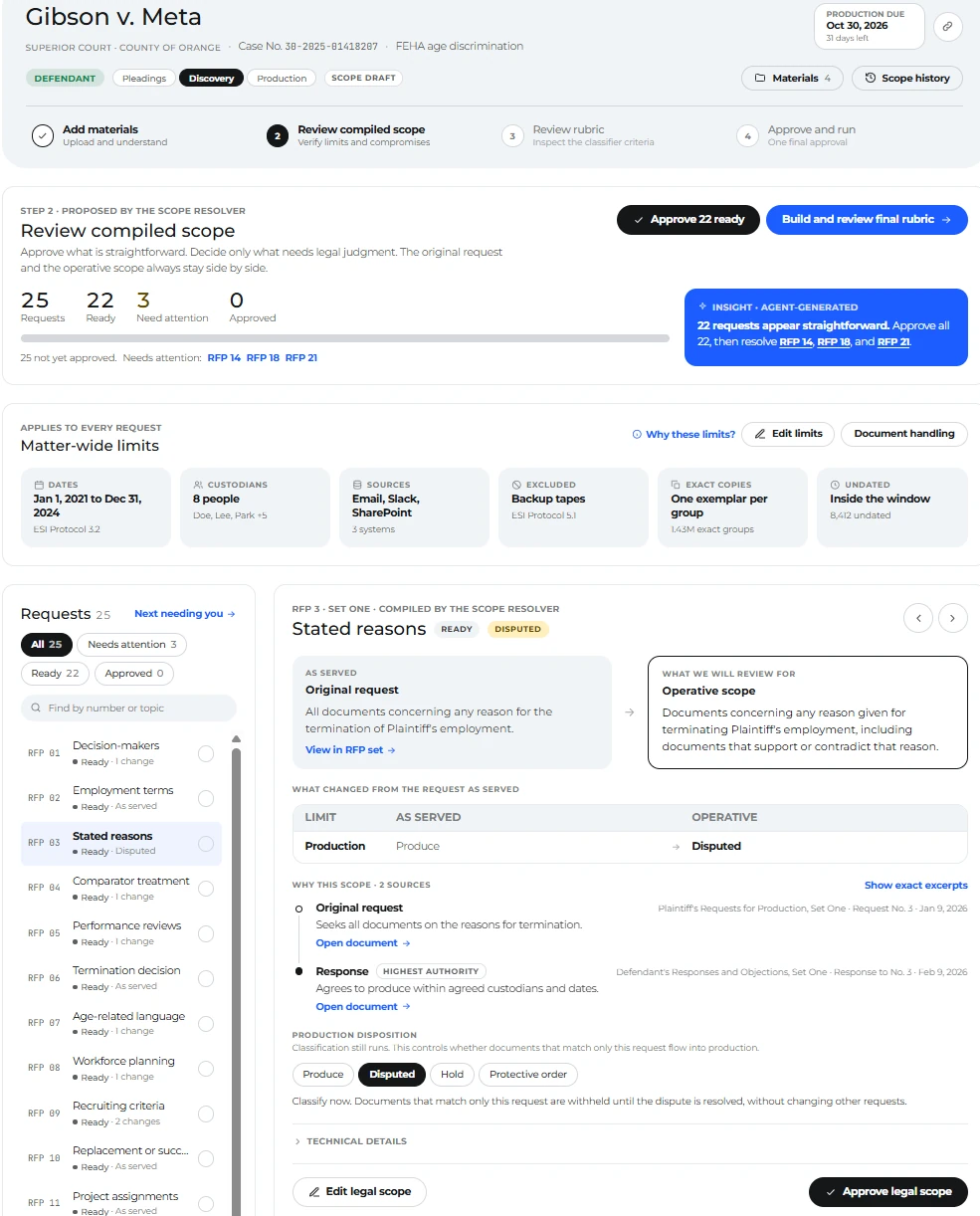
Requests for production are rarely what the producing party owes. Responses and objections, meet-and-confer letters, ESI protocols, stipulations and court orders all narrow them. Scope Bench reads that whole stack and compiles one attorney-approved definition of what must be reviewed, before a single document is classified.
Five-minute setup. Twenty-minute attorney review. One approval. Run.
Today an associate rebuilds the real scope in a memo or a spreadsheet. Too broad, and you over-review and hand over documents you never owed. Too narrow, and you under-produce into sanctions and failed recall checks. Scope Bench does the reading and the organizing; the attorney reviews legal meaning, not prompts or model output, and spends time only on the requests that need judgment.
- Add materials
Upload whatever papers you have. Each file is classified by type in seconds, and every request is matched to its responses, agreements, protocols and orders.
- Review compiled scope
Matter-wide limits sit on top: dates, custodians, sources, exclusions. Each request shows the text as served beside the operative scope, what changed, and the exact clause behind every change.
- Review the rubric
The questions the classifier will ask of each document, compiled from the approved scope, with the approved legal meaning beside each one.
- Approve and run
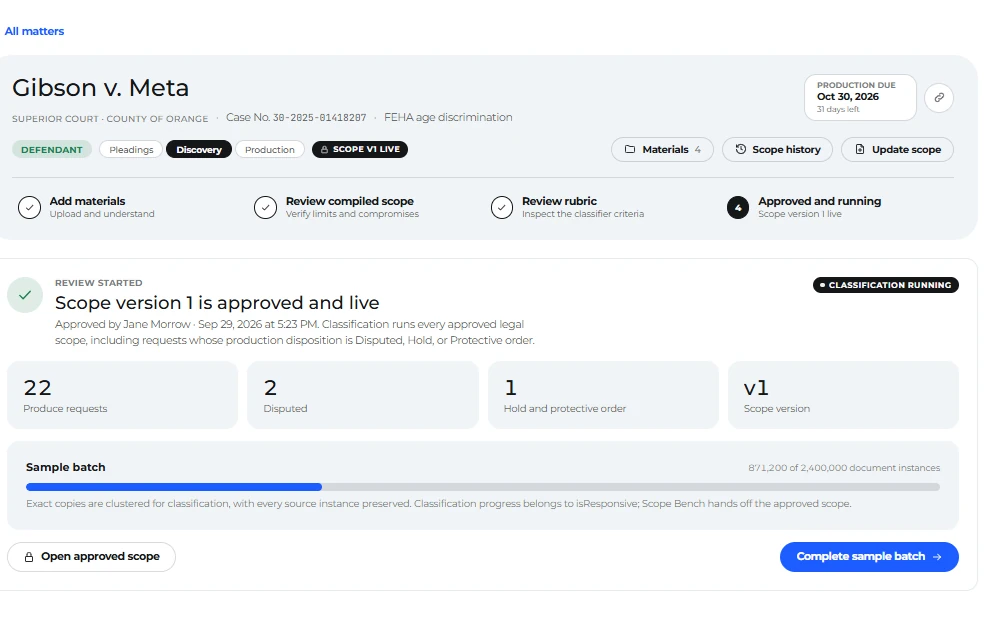
One approval locks a scope version: who approved it, when, and a fingerprint of exactly what was approved. Then classification starts.
For a typical 25-request matter, the aim is about 20 requests approved in bulk, 4 quick edits and 1 real legal decision.
Defensible by construction
- A clear order of authority. Court order, then stipulation or ESI protocol, then written agreement, then the served response, then the original request.
- No invented limits. A bare “overbroad” never narrows a request on its own. It comes back to counsel as a question.
- Every limit traced. Each one links to the document and the clause it came from.
- A full audit trail. Every action is logged with the user and the before and after values, and it exports.
Scope that keeps up with the case
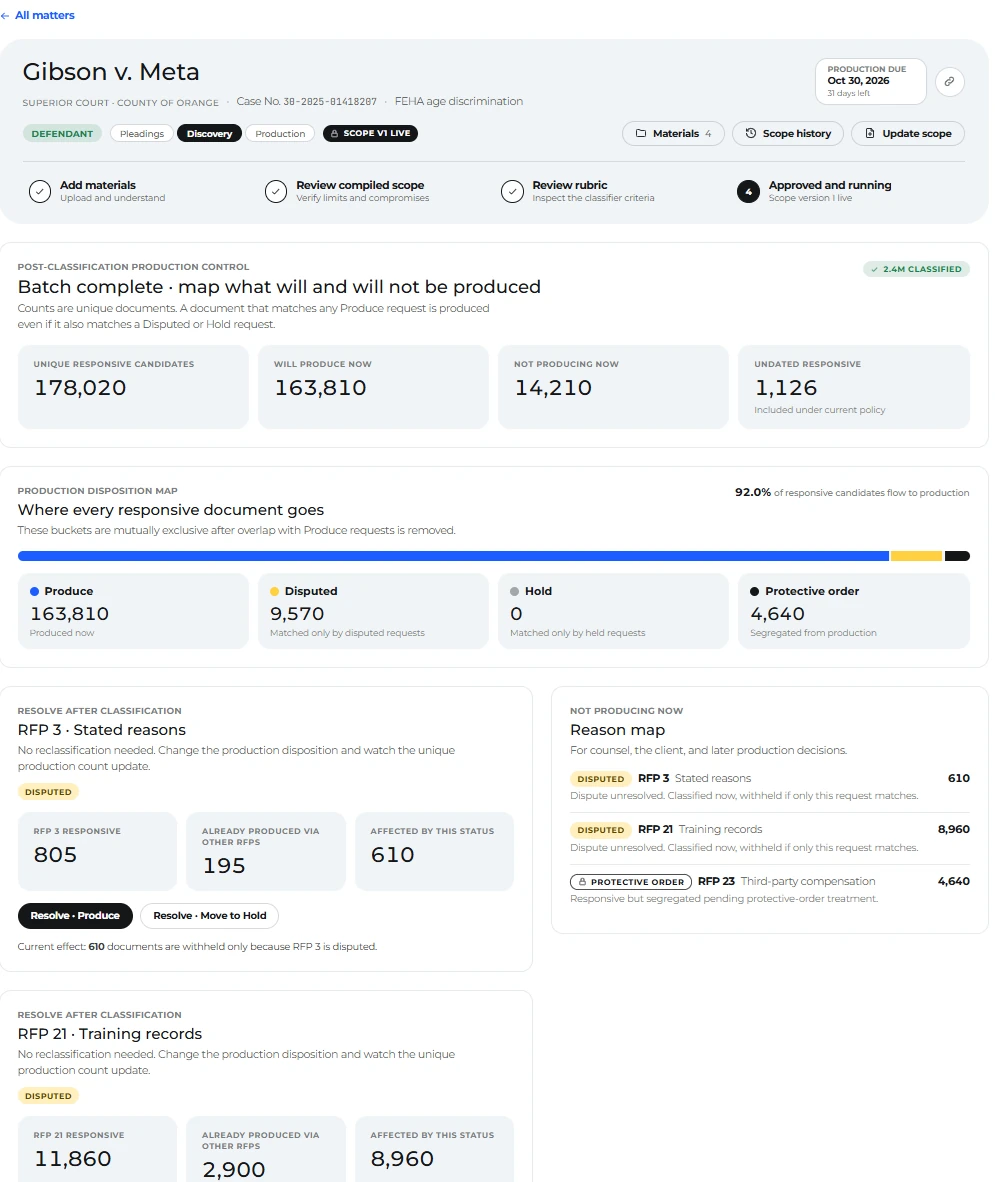
- Production control without a rerun. Each request carries Produce, Disputed, Hold or Protective order. A disputed request is classified now and settled later; resolving it updates the production count.
- New RFP sets. Only the new requests go through the four steps. Documents already produced are linked, not produced again, and earlier requests are never reopened.
- Supplemental responses, agreements and orders. Only the requests they touch come back for review. Everything else keeps its approval and its classification.
Partly privileged is not a reason to withhold the whole document.
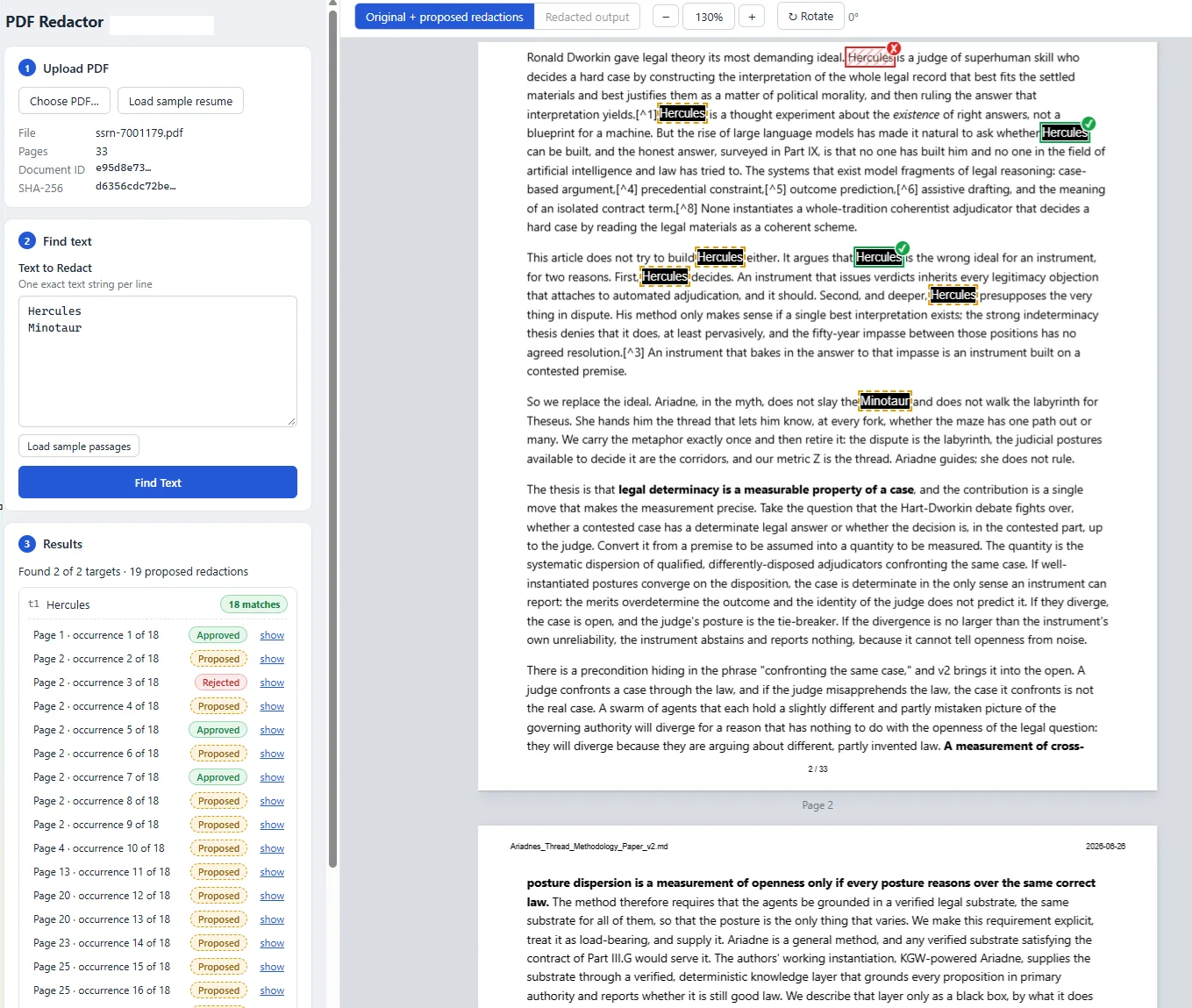
When only a section or a phrase of a responsive document is privileged, isResponsive v2 redacts it automatically and leaves the rest ready to produce. Counsel reviews each redaction in place and approves it in a click.
- Found everywhere it appears. Every occurrence is located page by page and shown on the page itself, not in a separate list you have to reconcile.
- Proposed, then decided. Each redaction carries its status: proposed, approved or rejected. Nothing is blacked out on counsel’s behalf without a decision.
- Fast to check. Jump to any occurrence, see it in context, approve or reject, and move on. Switch between the page with proposed redactions and the redacted output at any time.
- Pinned to the file. Each document carries its ID and a SHA-256 fingerprint, so the redacted output ties back to the exact file it came from.
A published method, version-pinned by design.
Court-defensible technology-assisted review does not require a proprietary black box.
It requires four controls: per-request rubrics locked by cryptographic hash before classification begins; a calibrated classification cascade optimized under explicit recall constraints; a deterministic privilege screen that routes every flagged document to attorney-only review; and a formal validation stopping rule that issues a Defensibility Certificate only when per-request recall bounds, elusion bounds and active-learning convergence are all satisfied.
The claim is procedural: defensibility turns on a measurable, documented, counsel-supervised process that an opposing party, special master or court-appointed expert can reproduce, not on trust in any particular model.
Four controls, one certificate.
Determinations per request, with receipts
Every document is scored against each request for production individually, with the criteria matched, the exclusions triggered, and citation spans quoting the exact text the call relied on.
Defensible by construction
Privilege screening runs first and deterministically. Confidence scores are calibrated on your own matter with hard gates that lock auto-accept when calibration degrades. The review ends in a Defensibility Certificate: per-request recall bounds, elusion measurement, and an audit chain hash-pinned to the exact criteria and thresholds used.
Wired into Discovery Framework
Sign the certificate and the responsive set, the per-request determinations and the citations flow straight into Discovery Framework: answers grounded in the responsive documents, the gaps in the other side’s production, the meet and confer letter, the Motion to Compel.
Discovery Framework →Measured, not promised
The system does not ask whether the point estimate looks good. It asks whether the lower bound clears the floor. Matter-level claims issue only through signed validation certificates; the worked example in the paper is proof of pipeline arithmetic, not a production claim.
A court-defensible artifact a frontier model cannot supply.
The Defensibility Certificate is the artifact you hand to a special master or a court.
Issued only when every gate is satisfied: a per-request recall lower bound above the floor, an elusion upper bound below the ceiling, and active-learning convergence. Hash-pinned to the rubric, the cascade, the calibration and the audit log. Signed by counsel. There is no override for a hash failure.
The paper is published. The engine comes with the platform.
Documented in public.
The methodology, the four controls and the certificate are set out in the paper on SSRN, so an opposing party, special master or court-appointed expert can check the process the certificate describes.
Read the paper →Included with the Legawrite.AI litigation platform.
Scope Bench, the review and privilege redaction come with it. The responsive set it certifies flows straight into Discovery Framework and the rest of LitigationOS.
The engine is shown in a demo, on documents we bring, so you can watch the privilege screen, the per-request determinations and the certificate arithmetic in one sitting.
Has to be 100% on premises? It runs on one desktop under a desk.
About 5% of matters have to stay entirely on premises. For those, isResponsive runs inside your firewall on a single desktop workstation, one RTX 5090 is enough, with zero calls to any AI vendor’s API. No server cluster, no data center, no rented hardware.
For the other 95%, the test is simple: if you can email a document, you can classify it with v2 without giving up privacy. The classification engine cannot train on your documents, even if you ask it to. It is not that kind of AI.
Keep your own documents.
The pipeline makes zero calls to any AI vendor’s API. There is nothing for anyone to subpoena from us, because we never have your documents. That is not a privacy policy; it is the architecture.
Read the paper. Check the arithmetic.
The methodology is written down, the worked example shows the pipeline arithmetic, and the Four Laws we build by are in the same paper. Read it before you believe a number on this page.